Week of June 28 - July 4, 2026
It was bound to happen: The heat of summer has arrived at my desert home. As I write these words, it's 115 F outside, and it's just the beginning of the blistering heat we'll experience for months.
This is no surprise, of course. We're all quite familiar with this seasonal pattern; in fact, most of us learned in grade school about the seasons and what causes them, but you'd be surprised how little some people remember of those basic lessons.
I was stunned when I first heard of a 1987 video in which filmmakers Matthew H. Schneps and Philip Sadler of the Harvard-Smithsonian Center for Astrophysics interviewed recent Harvard University graduates, faculty members and alumni — some with science backgrounds — and asked them a simple question: What causes our seasons?
Twenty-one of the 23 people interviewed did not know the answer. This is Harvard, people. Harvard! If you can't believe it, watch it online here.
Oh, sure, they offered elaborate explanations and tried to be convincing, but it's obvious they had no clue. The most common reason they cited for the summertime heat was that the Earth lies closest to the sun at that time of year, and the cold of winter is caused by our greater distance from the sun.
Sounds perfectly reasonable, doesn't it? But it's wrong. So very wrong.
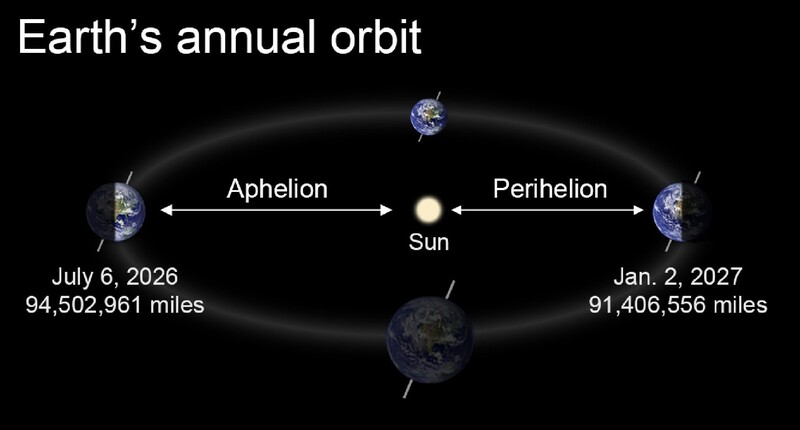
Now it is true that our planet orbits the sun not in a circular path but in an elliptical path, and that our distance from the sun varies throughout the year, but only by about 3%. What seems counterintuitive, however, is that we're closest to the sun not during our Northern Hemisphere summer but during our winter!
In 2026, the Earth will reach its farthest point from the sun ("aphelion") on July 6, when we will lie 94,502,961 miles from our star. This occurs during the Northern Hemisphere summer. The Earth's nearest point ("perihelion") won't arrive until Jan. 2, 2027 (during our winter), when we'll be 91,406,556 miles from the sun.
Of course, if you happen to live in the Southern Hemisphere, where seasons are reversed from those north of the equator, our planet's perihelion does occur during their summertime. But that's a story for another time.
So, if our distance from the sun doesn't cause seasonal temperature changes throughout the year, what does? Well, as we all learned in third grade, it's the tilt of the Earth's axis.
Our planet is tipped about 23.4 degrees to the plane of its orbit around the sun. From mid-March to mid-September, the Earth's Northern Hemisphere is tilted toward the sun, allowing solar rays to beat directly down upon us. During these longer days, heat accumulates in our atmosphere while having little time to escape into space during the much shorter nights.
In other words, it's not our changing distance from the sun that causes the buildup of summer heat; it's the tilt of our planet that produces long days and short nights — just as it always has.
Unfortunately, few still seem to understand this simple phenomenon, and I suspect if we did this same interview today, we'd see even less informed answers than four decades ago!
Visit Dennis Mammana at dennismammana.com. To read features by other Creators Syndicate writers and cartoonists, visit the Creators Syndicate website at www.creators.com.
Contrary to popular belief, the Earth's distance from the sun does not cause the change in seasons throughout the year.






View Comments